

After saying my goodbyes to WuWei, I took the train to LanZhou, Gansu—my mom’s hometown. There, I heard many interesting stories about her childhood and met several of her high school friends. They now worked in different fields and lived in different cities, yet the short anecdotes from thirty-or-so years ago seemed to bring them together again. I met Ms. Ci, principal of the tutoring organization, at the dinner table. She shared her favorite local dish with me and asked about my life in boarding school. After a brief conversation, she connected me with some of her coworkers who would assist me during my sharing session the next day.
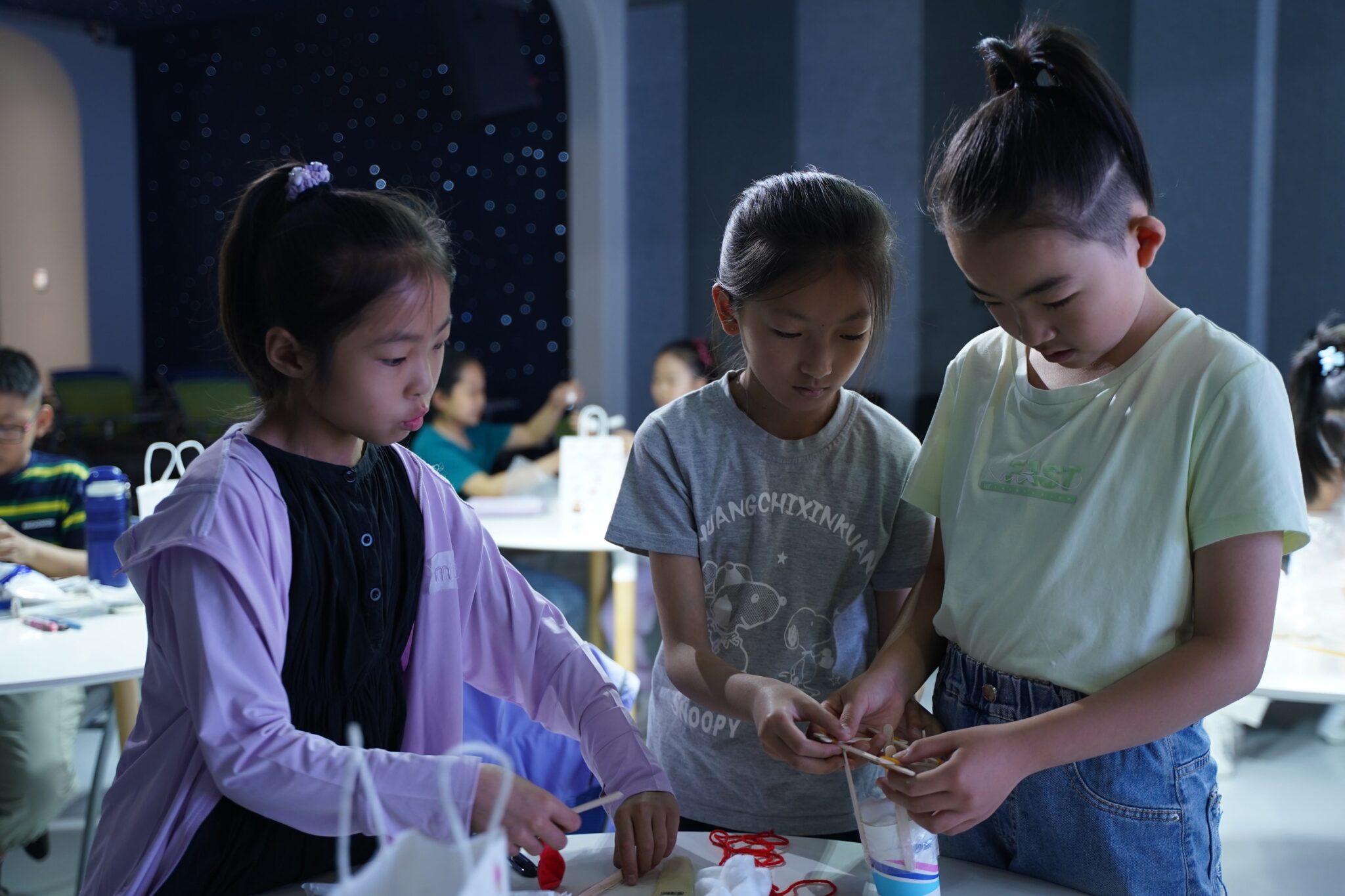
Having already led two sessions in WuWei, I was not as nervous as before. The routine was the same, aside from slight changes to my slides based on Mr. Liu’s feedback. Instead of showing several examples for each hands-on challenge, the slides now had only brief descriptions of the materials required and the goals. This way, students could let their imagination flow freely, rather than defaulting to copying or building on existing designs. The morning session went smoothly, with about 12 students and roughly the same number of parents. Compared with the WuWei session, the parents were more involved in activities—particularly interested in studying abroad—while the students were less interactive during my talk. I often found myself surrounded by parents eager to learn more about the different educational systems I’ve experienced and to share their opinions on their children’s studies. Through these conversations, I realized that, despite my efforts to move them away from test prep, I could not change the long-standing educational system—nor eliminate the college entrance exam. All the parents already knew that solving practice problems repetitively was not the most effective learning strategy. Yet, they lacked the time to prepare for tests and learn through applications simultaneously. This was the moment I decided to shift my focus—not only emphasizing learning through application but also stressing the importance of thinking logically at all times and learning by analogy.
At first, I was worried about the parents’ involvement. I thought it might prevent students from leading their own projects, and that those working alone would feel discouraged. As time went on, however, I realized I had overestimated the latter. Students who worked alone often showed more passion, creativity, and confidence in presenting their ideas. They approached the exercise like “professional researchers,” coming up with ideas and hypotheses, designing and testing models, refining their work, and finally presenting it to the small community. One student in particular stood out. Out of the three challenges I designed, there was one that no one in the three previous sessions had completed successfully before: building a balloon-powered car. The instructions were straightforward, but limited materials and the need for precision made it difficult. The force that the air in the balloon exerted was weak but long-lasting; cardboard wheels on wooden axles were nearly impossible to spin quickly. These were all details I had not thought of before. Though I saw a variety of designs—like a boy who made it rocket-shaped with intricate details, and some who tried to use materials from other kits instead—none of them moved when placed on a smooth surface. I warned the last group to choose this project only if they were comfortable with less-than-ideal results. Still, out of more than ten students, one girl decided to take on the challenge. When she came up to me to grab the materials, I repeatedly asked if she was sure about working on this, even if it ended up somewhat disappointing. I even decided in advance to give her a prize for her hard work regardless of her outcome. She nodded and went back to her desk, where she sat alone—a contrast to the other groups—and began planning her design. Her eyes were always fixed on her work whenever I checked on her. When she told me the cardboard was hard to cut smoothly, I offered help, but she smiled and declined. By the time it was her turn to showcase her work to the group, I was eager to see what she had done. She came over with the balloon-powered car between her hands and walked us through her design. I could feel her passion through her words. She overcame every challenge and considered all the intricacies in her design. The car zigzagged across the table; her hard work had paid off. The wheels didn’t have to rotate if friction was minimized (by covering the edges with tape), and the opening of the balloon didn’t have to connect with a straw. She proved—to me and to everyone else—that persistence, logical yet unconventional thinking, and hands-on problem solving could achieve the “impossible.”
In addition to my sessions with elementary and middle schoolers, I also hosted a brief session with around 200 high school sophomores at a local public high school. There, I focused on the importance of exploring courses outside of school, interdisciplinary fields and STEM applications, confronting social norms and stereotypes, and—most importantly—finding their passion. While some, due to the heavy workload in school, did not care as much (one student even asked me to translate two words into Chinese for his English homework during the Q&A), others gave me their undivided attention.
Apart from giving talks and organizing activities, I also surveyed around 200–300 people—from students (right before and after my sessions) to adults (a couple of months prior to my visit)—about their thoughts on STEM and their career paths. Although I have not had the chance to sit back and read through each response in detail, it was interesting to see the interdisciplinary careers I mentioned to students appear in their answers to “What profession do you want to pursue in the future?” I may never know whether my talks at least partially influenced their answers, but I hope my short visit planted seeds for new paths and perspectives.


